Section: Family · Everyday tips
Chores and Allowance by Age: A Guide for Ages 1 to 10
Which chores fit each age from 1 to 10, how many minutes a day, when to start an allowance, how much to pay and what the research says.
We earn a commission if you buy through links on this page, at no extra cost to you. It never changes what we pick. How we make money.
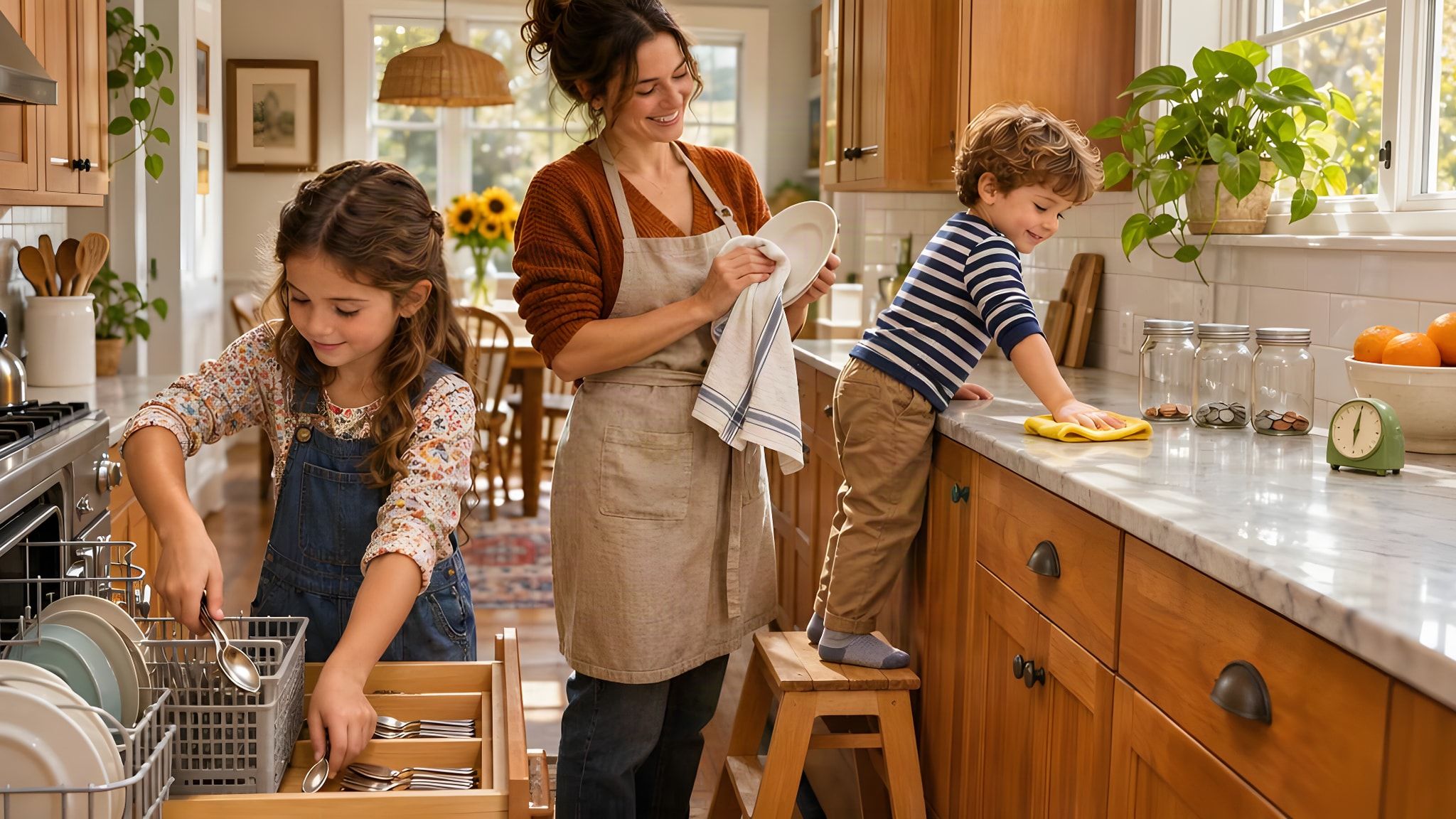
Start with one small job your child can finish alone, then add a second one when the first stops needing reminders. Money can wait until about age 5.
Chore to try
Tap the box next to a chore once you've done it.
Chores by age at a glance
Each age keeps the jobs from the age before and adds a few. Times are a starting point, not a rule.
| Age | Jobs to start with | Minutes a day | Allowance |
|---|---|---|---|
| 1 to 2 | Toys in the bin, cup to the sink, diaper in the trash | About 5 | Not yet |
| 3 to 4 | Feed the pet, match socks, set napkins on the table | 5 to 10 | Not yet, or a sticker chart |
| 5 to 7 | Make the bed, empty the dishwasher, sort laundry | 10 to 20 | Start around 5 |
| 8 to 10 | Pack lunch, vacuum a room, fold and put away laundry | 15 to 30 | Weekly, with saving |
Why start chores early
Small kids want to help. In a well-known experiment, 18-month-olds helped an adult pick up a dropped object without being asked or thanked (Warneken and Tomasello, published in Science).
Chores are also linked to the skills kids use to plan and finish things. An Australian study of 207 children ages 5 to 13 found that kids who did more chores scored higher on parent-rated working memory and self-control. It shows a link, not proof that chores cause it.
I’ll admit the toddler study surprised me. The urge to help is already there, so the job is mostly not to squash it.
Chores for ages 1 to 2
At this age a chore is something you do together, with the child doing the last step.
- Start here Put toys back in one low bin.
- Carry a plastic cup to the sink.
- Throw a diaper or a tissue in the trash.
- Put dirty clothes in the hamper.
- Wipe a small spill with a cloth.
Keep the bins low and use photos on the boxes instead of words. Thank them for the help, not for the result.
Chores for ages 3 to 4
Preschoolers can finish a short job on their own if the steps are clear.
- Feed a pet with a pre-measured scoop.
- Set napkins and spoons on the table.
- Match socks from the clean laundry.
- Water plants with a small can.
- Put shoes on the shoe rack.
- Help put groceries away in low cupboards.
A 3-minute timer helps. Many kids will race a timer happily and stop arguing about the job.
Visual Timer for Kids, 60 Minute
- Size
- 3 x 3 in face, 2.83 in deep
- Batteries
- 2 AAA (included)
Under $15 see today's price at Amazon
Check price of Visual Timer for Kids, 60 Minute at AmazonPhotos: LIORQUE
Read our full notes Hide our notes
Chores for ages 5 to 7
Now kids can own a few daily jobs and check them off a chart without help.
- Make their bed, the kid version.
- Empty the silverware from the dishwasher.
- Sort laundry into lights and darks.
- Clear their own plate and scrape it.
- Tidy their room before dinner.
- Pack their school bag the night before.
- Help cook by washing vegetables or stirring.
This is also a good age for picture or word cards on a chart. Reading the list on their own is half the fun.
Magnetic Responsibility Chart & Kids Calendar
Ages 3 and up
$25 to $50 see today's price at Amazon
Check price of Magnetic Responsibility Chart & Kids Calendar at AmazonPhotos: Melissa & Doug
Read our full notes Hide our notes
Chores for ages 8 to 10
At 8 to 10, kids can do real household work with a short lesson first.
- Pack their own lunch.
- Vacuum one room.
- Fold and put away their laundry.
- Take out the trash and recycling.
- Load the dishwasher.
- Make a simple breakfast, like toast or cereal.
- Clean the bathroom sink and mirror.
Show the job once, do it together once, then let them do it and check at the end. Expect a few streaky mirrors.
Should you pay kids for chores?
No study compares paying for chores with a fixed allowance, so this is a family choice. Here are the three models families use most.
| Model | How it works | Works well for | Watch out for |
|---|---|---|---|
| Fixed allowance | Same amount each week, not tied to chores | Teaching budgeting | Kids may skip chores |
| Pay per job | Money only for finished jobs | Kids who like to earn | Kids may refuse unpaid help |
| Hybrid | Family jobs unpaid, extra jobs paid | Families who want both | Needs a clear list of each |
Research on rewards is one reason to consider the hybrid. A review of 128 experiments found that expected, tangible rewards tend to lower interest in a task, more in children than in adults, while praise tends to raise it (Deci, Koestner and Ryan, Psychological Bulletin).
A toddler study points the same way. When 20-month-olds got a small reward for helping, they helped less once the rewards stopped. Kids who got praise or nothing kept helping.
When to start an allowance
Around age 5 is a common time to start. By then many can count coins and wait a few days for something they want.
The Consumer Financial Protection Bureau describes ages 3 to 5 as the years when planning and self-control grow fast, and ages 6 to 12 as the years when money habits form. Those are broad ranges, not deadlines.
Before 5, skip the money. Praise and a sticker chart do the same job.
How much allowance by age
A common starting rule, used by Greenlight and Ramsey Solutions, is 50 cents to $1 a week for each year of age. Then adjust it to what the money has to cover.
| Age | Weekly allowance to start with | What it might cover |
|---|---|---|
| 5 | $2.50 to $5 | Small toys, stickers, candy |
| 6 to 7 | $3 to $7 | Small toys, a book fair book |
| 8 to 10 | $4 to $10 | Toys, gifts for friends, an outing |
For context, a 2025 Wells Fargo survey of 1,587 parents found that 71% give an allowance, at $37 a week on average. That figure covers kids up to 17, so it runs high for young children.
If you raise the amount, hand over a cost along with it. A kid who now buys their own snacks at the school store needs more money, not just more fun money.
Save, spend and share jars
Three jars make money visible for kids who can’t yet read a bank statement. Label them save, spend and share, and split each payday together.
- Ages 5 to 7: half to spend, a little less to save, a little to share.
- Ages 8 to 10: about a third in each jar, with a savings goal taped to the save jar.
Talking about the jars matters more than the jars. A study of adults’ memories found that pocket money paired with parents’ advice on saving was linked to saving more as adults, while pocket money alone was not (Bucciol and Veronesi, Journal of Economic Psychology). In the OECD’s PISA 2018 test, 15-year-olds who learned about money from their parents scored 27 points higher in financial literacy.
Classic Moneybox (Save, Spend, Share)
Ages 3 and up
$15 to $25 see today's price at Amazon
Check price of Classic Moneybox (Save, Spend, Share) at AmazonPhotos: Moonjar
Read our full notes Hide our notes
When kids push back
Every kid refuses a chore sometimes. A few lines that help:
- “I don’t want to.” “I get it. It takes four minutes, and then you’re done. Want to race the timer?”
- The job is half done. “Almost. Show me the last part and we’ll call it finished.”
- “Why do I have to?” “Everyone who lives here helps keep it running. You’re part of the team.”
Skip the long speech. A short line and the same routine every day work better than a lecture.
Need a distraction for the slow part? A joke for kids mid-tidy buys you two more minutes.
This is the part I find hardest, honestly. Doing it yourself is faster today and slower for the next ten years.
How we put this together
We built this guide from published research and from the age ranges popular family money guides use. It is desk research, not a hands-on test.
The sources are listed below, and how we pick explains our method. For more ideas for ordinary days, browse the Family hub.
FAQ
At what age should kids start doing chores?
Around 18 months to 2 years, as helping rather than a job. In lab studies, toddlers of 18 months already help adults without being asked. Start with one or two tasks they can finish, like putting toys in a bin.
At what age should a child get an allowance?
Around age 5, once a child can count coins and wait a few days for something. Several kids' money apps start at 5 or 6. Before that, praise and a sticker chart do the job.
How much allowance should a kid get?
A common starting rule is 50 cents to $1 a week for each year of age, so $3 to $6 for a 6-year-old. Adjust it to what the money has to cover. In a 2025 Wells Fargo survey, parents of kids 5 to 17 gave $37 a week on average.
Should you pay kids for chores?
No study settles it. Many families split chores in two: family jobs everyone does for free, and extra jobs that earn money. Research on rewards suggests paying for every task can make kids less willing to help on their own.
How long should kids spend on chores each day?
There is no official number. As a starting point, try about 5 to 10 minutes a day for toddlers and preschoolers, 10 to 20 minutes for ages 5 to 7 and 15 to 30 minutes for ages 8 to 10.
Should you take away allowance as a punishment?
Many family money guides advise against it, because it ties money to behavior instead of to work or budgeting. If an earned job isn't done, it simply isn't paid. Handle behavior with a different consequence.
How we put this together
Every fact on this page comes from a source listed below, and we leave out the ones we can't trace. The ideas are our own. We don't give health advice here. Nobody pays to be here. Read how we work
- Warneken & Tomasello (2006), Altruistic helping in human infants and young chimpanzees, Science 311:1301
- Warneken & Tomasello (2008), Extrinsic rewards undermine altruistic tendencies in 20-month-olds, Developmental Psychology 44(6)
- Tepper, Howell & Bennett (2022), Executive functions and household chores, Australian Occupational Therapy Journal 69(5)
- Deci, Koestner & Ryan (1999), A meta-analytic review of experiments examining the effects of extrinsic rewards on intrinsic motivation, Psychological Bulletin 125(6)
- Consumer Financial Protection Bureau, Building blocks to help youth achieve financial capability (2016)
- Bucciol & Veronesi (2014), Teaching children to save, Journal of Economic Psychology 45
- OECD, PISA 2018 Results (Volume IV): Are Students Smart about Money?
- Wells Fargo, 2025 allowance study with Ipsos (July 2, 2025)
- Greenlight, Average allowance by age for kids and teens
- Ramsey Solutions, Chores for kids
First published Nov 19, 2026
Spotted a mistake? Report an error